The Hands That Pick the Tea


The tea fields of Limuru wake before the sun does.
By the time dawn breaks over the Tigoni highlands, hands are already moving — steady, practiced, rhythmic — plucking the two leaves and a bud that will eventually find their way into tea bags sold across the world. These hands belong mostly to women. Many of them are young. Some are girls who should, by any measure, still be in school.
Kenya is the world's largest exporter of black CTC tea. It is a fact celebrated in headlines, in trade reports, in export statistics. What is less celebrated — less legible in those numbers — is the life that makes that export possible. The communities that cultivate Kenya's most iconic crop are, in many places, quietly struggling. And in Limuru, where the country's tea story began in 1903, those communities are the very ones Kimlea Technical Training College was built to serve.
The history of Kenyan tea is inseparable from Limuru. It was here, in the cool highlands of what is now Kiambu County, that the first tea seedlings were introduced by colonial settlers. It was here that large European-owned estates set the terms of labour for decades — terms that kept African growers locked out of ownership until 1956, and that shaped an entire culture of casual, low-wage employment that persists in parts of the region to this day.

In Kiambu County, where Limuru sits, an estimated 25% of the population live in absolute poverty. Women who labour in the fields often earn below the minimum wage. According to Kenya's Tea Directorate, over 60% of labour on tea farms is provided by women — yet most lack access to higher education or formal employment training. They are essential to an industry that does not see them as central.
To understand what poverty means in a tea-farming household, you have to look past the income figures.
It means that a family's annual income from tea farming can average around KSh 97,000 — spread across multiple dependents, with a dependency ratio approaching 0.9. It means that most parents in these communities have completed only primary school, and that the educational ceiling they reached tends to become the floor their children are expected to break through — often without the resources to do so.
It means that a daughter's school fees compete directly with household survival. That when money runs out, it is usually the girl who stays home. That "staying home" rarely means waiting — it means joining her mother in the fields, or taking on domestic labour that fills the hours where education once was.
It means that healthcare is an afterthought, not a right. That a woman in labour in a remote tea-farming community faces real risk. That malnourishment among children is not an abstraction but a lived condition that teachers and community health workers encounter regularly.
This is the world many of Kimlea's students come from. Not as a backdrop. As the defining reality of their lives.
Poverty is not gender-neutral. In tea-farming communities, as in many agricultural economies across Kenya, girls absorb its costs in particular ways.
When a household cannot meet the cost of school fees, it is rarely the sons who are withdrawn first. Research consistently shows that girls' dropout rates in secondary schools in Kenya are higher than boys', driven significantly by economic hardship, early marriage, and pregnancy. One study of out-of-school girls across rural Kenya found that financial reasons , lack of fees, needing to work ,accounted for nearly 43% of dropout cases. Marriage, pregnancy, and needing to care for children accounted for a similar proportion.
In Kiambu County, the child marriage rate among girls aged 12–18 sits at 3.3% — low by national comparison, but not absent. Every percentage point represents real girls, real futures interrupted. And what the statistics do not capture is the softer pressure: the cultural expectation that a girl from a tea-farming family will follow a familiar path. Plucking. Marrying young. Starting again.
Child labour on tea and coffee estates in Kiambu County has been specifically identified by Kenya's national plans as an area requiring intervention. The U.S. Department of Labour has noted Kenya's work — including new international partnerships formed in 2024 — to eliminate child labour from tea and coffee supply chains. Progress is being made. But it is slow, and the economic conditions that drive it have not changed overnight.
For girls between 16 and 22 — the age group Kimlea's full-time programme is designed for — the window between childhood and economic necessity is narrow. Education is not simply aspirational. It is a race against circumstance.
What makes poverty in tea-farming communities so tenacious is not the absence of ambition. It is the absence of alternatives. A woman who grows up plucking tea, who has no secondary school certificate, no vocational qualification, no exposure to other industries — what does she do when the harvest is poor? What does she tell her daughter when the fees come due? The cycle is not about willingness. It is about infrastructure. About what pathways exist, and who they were designed for.
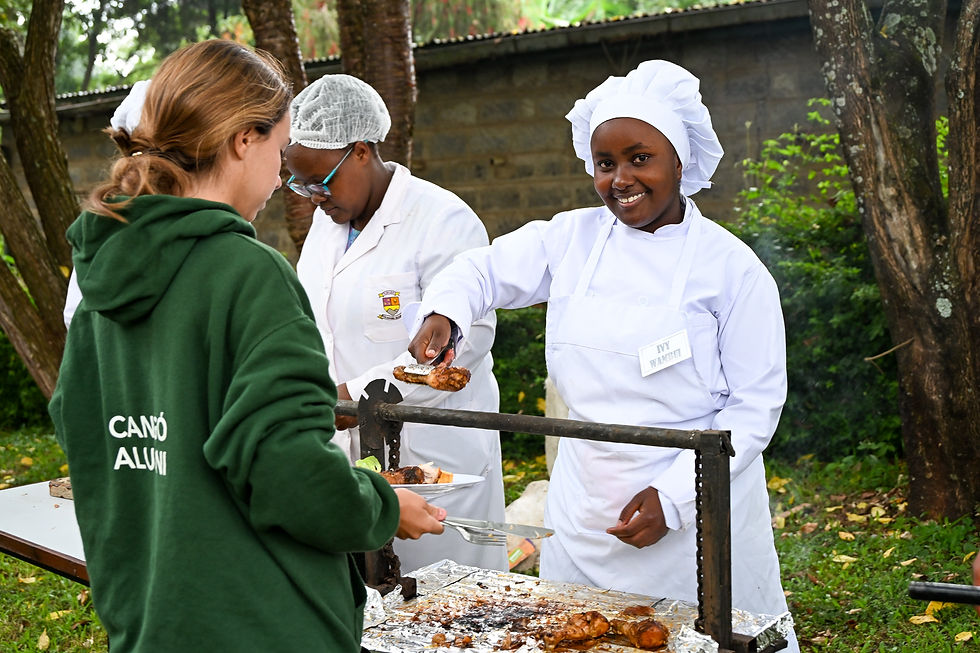
Kimlea exists because Kianda Foundation looked at this landscape and chose to intervene. Since 1992, the college — situated in Tigoni, at the heart of the tea country it was built to serve — has trained more than 12,000 women and girls from plantation communities. It offers subsidised education, practical hospitality and catering skills, mentorship, and human formation. It offers the Kimlea Clinic, which sees over 3,000 patients annually, most of them tea workers and their families. It offers what no amount of tea revenue guarantees: a way out that does not require leaving behind who you are.
67 % percent of Kimlea alumni contribute to their family's income within six months of graduation. That number is not just a metric. It is a story about what becomes possible when a girl from the tea fields is given time, skills, and the belief that her life can be different.

Limuru is 21 kilometres from Nairobi. Close enough to see the skyline on a clear day. Far enough that the world of opportunity it represents can feel like a different country.
The women and girls of Limuru's tea communities are not waiting to be saved. They are already working — harder than most, for less than most, in conditions that demand everything and guarantee little. What they need is not charity. It is what every person deserves: education. Healthcare. A skill. A chance.
The tea in your cup this morning was, in all likelihood, touched by a woman in the Limuru highlands. She rose before the light did. She worked until her hands were stained and her back ached. She came home to a family that depends on her.
She deserves to know that someone is thinking about her daughter.
Kimlea Technical Training College is a project of Kianda Foundation, dedicated to transforming the lives of women and girls from tea and coffee farming communities in Limuru, Kenya.


Comments